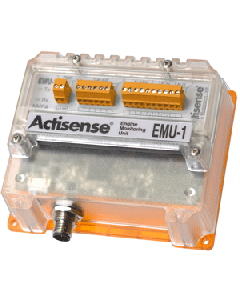
It’s great to try out an unusual device that promises to do something new and desirable for the right Gizmo ship and to find that it’s pretty easy to set up and works quite well. This Actisense EMU-1 now converts the vessel’s 14 year old Volvo Penta diesel analog measurement data into NMEA 2000 messages that can be displayed in multiple ways on virtually any MFD or on-board instrument display and can also be displayed. Personalized, alerted and recorded. . I will be better informed about the health of my engine, which is very important, while having as little space on the helm panel for better use than silly analog gauges…
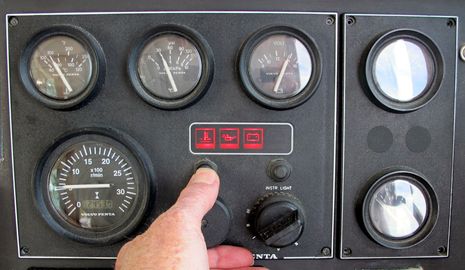
I’m too conservative to completely remove the old Gizmo gauges (like the old set on the lower rudder), but I’m already confident enough in the EMU-1 data that I plan to move it to a dark place when this winter, I have a change of image of the “glass bridge”. By the way, a nice nuance of the EMU-1 is that each of its 6 measuring channels can automatically detect the presence of an analog brother, adjust the calibration curve and also the power of the transmitter can control For example, if the old coolant temperature indicator (top left) fails, the EMU will continue to provide the temporary information if the transmitter is working, at least in theory … and if the EMU network or N2K fails, the meter will continue to work! The redundancy that I like! (The three fault LEDs and associated audio alarms are another issue, which I’ll explain later.)
The most tedious part of the setup was to connect all those thin tachometer, meter, and alarm signal wires that can be seen at the EMU-1 terminals (top photo) to the correct wires on the back of the old meter panel. Removing the panel made the job easier and I also used 3M Scotchlok IDC faucet fittings which will eventually have their own Panbo inlet. Then came the exciting moment when I turned on both the Volvo Penta (whose ignition now also activates the EMU-1) and the old EMU Config Tool software. (It is necessary to have an Actisense NGT-1 gateway between the N2K boot network and the PC you are using, but there are many other good uses of the gateway, such as sending boot information to a device. compatible. instrument program.)
The tool is quite simple; The drop-down menus allow you to specify which signal is associated with which terminal, and then select the possible calibration profiles for the meter. There isn’t much custom calibration until Actisense adds it (programmed), but in most cases the digital signals seem to match my analog readings pretty well. The exception is the coolant temperature, which is about 15 ° high (I have a Maretron temperature sensor on the block, which confirms the analog gauge). I’m hoping to get the correct temporary numbers as the configuration tool evolves, but actually the number I get is pretty useful because it’s consistent. I also had to play around with the RPM ratio until it matched (which I always considered) with the reality of the tach, and that was it…
There are many ways to display N2K information on Gizmo, but for the real details nothing beats Actisense’s NMEA reader (or Maretron’s N2KAnalyzer). All PGNs (messages) from SRC (source) 13 on the above screen are from EMU-1 and the right panel is a breakdown of PGN 127489 “Motor Parameters, Dynamic”. Engine speed, boost pressure and tilt / the offsets are in the “Engine, quick update”, the PGN turns off every 0.1 seconds, and of course the Gizmo transmission oil pressure is in the message “Transmission, dynamic”. It’s a great way to see what a device like the EMU-1 is doing and what else it could do (if it had the right sensors).
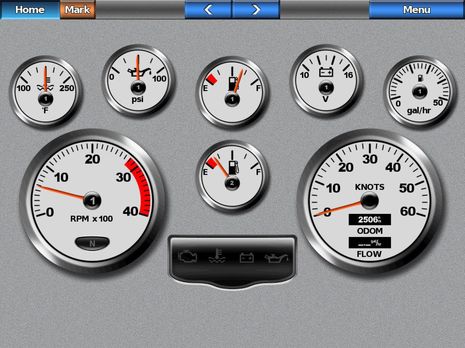
Here’s how some of that same data might be displayed very well, in this case on a Garmin GPS Map 7212, which even asked me if I wanted to set the engine to maximum rpm when it first saw the tach EMU message- 1. New Garmin displays such as the GPSMap 741 and the GMI 20 instrument (Panbo see here) will automatically select gauge types based on received PGNs, although neither place a transmission oil pressure button ( although the digital data may not show a problem). Garmin also allows you to set limits for any digital meter and is probably the best at deciphering and viewing the “fault lights” associated with the alarm switch connections on the EMU-1. (If the Gizmo ignition is on without the engine running, the low oil pressure warning above will “come on” and I was able to clear the overheat alarm by temporarily setting it to “low “with the configuration tool.)
But while you can’t change the gauges displayed in Garmin’s engine windows, you can make all kinds of changes on the Raymarine e7 screen above. Except the only gauge you can set limits for is RPM. Sometimes it doesn’t matter, but when the fixed engine voltage knob goes from 0 to 60v for example, it’s not very useful for monitoring a 12v alternator. The good news is that all N2K display developers are doing better than before with engine information, and this trend could accelerate as devices like the EMU-1 (and newer ECI-100 from Ray) are becoming popular. .
 BOEMARINE